Les Cahiers du Studio installation and user guide
Introduction
This application was designed for and with the Studio de Théâtre de Vitry by L’Atelier des Chercheurs. For credits and explanations, see the Github page.
Les Cahiers du Studio is under the free license CC BY-NC-SA, which means that anyone can download, use, modify and share it again as long as it is not used commercially (for example, selling the software or paid training on the software). Credits must remain clearly visible, including in modified versions of this application.
Development happens on the following page: github.com/l-atelier-des-chercheurs/Les-Cahiers-du-Studio
Installation
The links to download the application for macOS, Windows and Linux are on the dedicated page in the tools section of this website.
on macOS
On macOS, installing requires a small extra step because the application was not signed by Apple (unlike App Store applications, for example).
So, to start Les Cahiers du Studio, the easiest is to right-click the icon and choose "Open" the first time you open it after installing. For more information, see the following Apple support page: support.apple.com/kb/PH25088.
Les Cahiers du Studio works on macOS 10.9 (Mavericks, from 2013) and newer systems.
To install the application on macOS:
- Download the DMG file from the link above
- Double-click it
- Drag the application to your Applications folder
- Open the app by right-clicking it, then Open
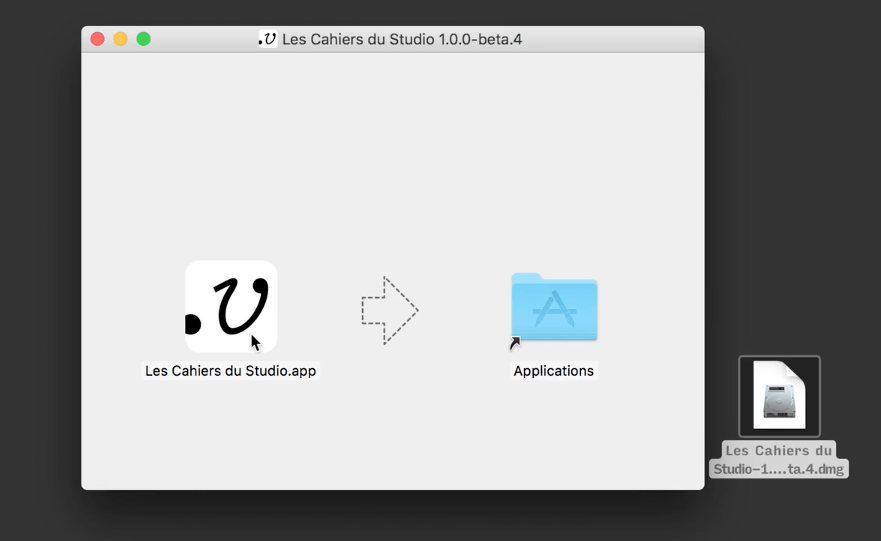
You can also watch the video Les Cahiers du Studio • installation et prise en main (installation and getting started) below to see how to install the application on macOS.
on Windows
Les Cahiers du Studio requires at least Windows 7. The operating system must also be 64-bit – which is the case for almost all computers and all recent machines.
To install the application on Windows:
- Download the EXE file from the link above
- Double-click it and follow the steps
on Linux
Les Cahiers du Studio is provided as an AppImage, which ensures fairly broad compatibility. To install an AppImage, make it executable, then open it.
More information: appimage.org/
Getting started
Creating folders and importing media
This video shows how to install the application on macOS and how to import media into the application afterwards (in French).
You can also document while creating, using several devices connected to the computer running the application. In this case, the devices must be on the same wifi network and open the address shown in the sidebar in a web browser.
All content is synced to all connected users: it is stored on the computer running the application, but can be viewed, edited and downloaded by everyone. This can be useful to give a group access to a PDF document, for example.
Navigating and exploring the traces
The interface offers several tools to explore and find media in the timeline. The following video presents most of them (in French).
Saving and sharing content
By default, content is stored in the My Documents folder, in a subfolder named les-cahiers. Here is an example of what this folder may contain.
- the _bin folder contains all the folders that were removed. To restore them, move them out of this folder. You can also confirm their removal by deleting them (right-click / move to trash).
- the _thumbs folder contains all the generated previews. These previews are used in the timeline. They can be regenerated by deleting the whole _thumbs folder and reopening the folders in the application (this takes between 1 and 30 seconds, depending on the number of media).
- folders whose name does not start with a _ character are shown in the platform.
Saving
To save or transfer content, proceed as follows:
- close the application if it is open
- go to the My Documents/les-cahiers folder (or Documents/les-cahiers, depending on your operating system)
- copy the folder(s) you want to save or transfer outside the les-cahiers folder. You can send them on a USB stick or by any other means. You can also compress the folder (right-click, compress) and share it via Dropbox/Wetransfer/email (keeping in mind that email attachments are usually limited to 25MB, which is not much).
You can also save all your content at once by copying the les-cahiers folder directly. In this case, to save space, it is recommended to delete the _bin and _thumbs folders. The _thumbs folder and its content will be recreated automatically the next time they are needed.
Sharing
Following on from the previous point, you can easily transfer a whole captured session to another computer that also has Les Cahiers du Studio installed. To do so, simply copy a whole folder and paste it into the My Documents/les-cahiers folder of the target computer. There is no need to copy the corresponding _thumbs content: the previews the program needs to open this folder will be recreated automatically if they are missing.
How content is stored
Meta data and folder creation
A folder’s information is stored in a meta.txt file located directly in this folder. This file defines the folder’s own information. For example, here is the meta.txt file of a folder named hello-world:
If a folder has no meta.txt file when the application starts, one will be created automatically using the folder name as reference (for example, a folder named recording will be called recording in the interface). This can be useful if you want to create many folders on the fly without going through the interface.
Note: make sure to only use valid folder names: no spaces, no special characters, no capital letters. “First Folder” is not a valid name, while “first-folder” is. Once Les Cahiers is running, you can then change the name to one with spaces and special characters. This “human” name will then be stored in the meta.txt file located directly in this folder.
Media storage
All media are stored directly in the corresponding folder:
As with folders, each media has a corresponding "meta" file. Each media is therefore independent: media can be removed or added directly from the file explorer. If you paste an audio or video file into a folder, its meta file will be created automatically, named after the media with the .txt extension, with the following information:
- timeline date (date_timeline) — the date used to place the media, and the only date editable in the interface
- creation date (date_created) — taken from the EXIF information for a photo, or directly from the original file (optional)
- upload date (date_upload) — set when the media is uploaded to the timeline (optional)
- modification date (date_modified) — date of the most recent change to the media
- public — whether it is marked as public or private
- color — the color of its marker
- type — the media type, based on the file extension: video, image, audio, etc.
- collapsed — whether it is collapsed or not
- ratio — its ratio, taken directly from the media
- keywords — a list of keywords
- authors — a list of author(s)
Most of this information can be changed in the interface, although it can also be filled in by hand by editing the text files.
Changing the welcome text
The text in the banner of the home page can also be changed:
To do so, go to the Documents/les-cahiers folder (see the section Saving and sharing content) and open the presentation.md file it contains in a text editor, such as Notepad or TextEdit. You should see the following content:
The content can be written as plain text or in markdown (that is, following the same syntax as texts and markers), see the section Getting started.