CHéPA — The Newspaper For Everyone
From September 2018 to April 2019, the 9th grade students of class 3ème1 at the Jean-Pierre Timbaud middle school worked on making a newspaper about sexism called CHéPA. The starting point of the students’ reflection was the exhibition Computer Grrrls (Gaîté Lyrique, March-June 2019) and the place of women in the history of computing.
Here is the report of Sarah, who led the workshops.
See the newspaper online (in French)
Download the newspaper as a PDF (in French)
Report of a workshop at the Jean-Pierre Timbaud middle school, Bobigny
I kept a logbook throughout the workshop. At first, the session reports are written as notes; then I decided to turn this logbook into more of a narrative, to be more precise about this experience and about the use of do.doc.
Introduction

Wednesday September 19th, 2018, Bobigny
First workshop at the Jean-Pierre Timbaud middle school, with the 9th graders of the cooperative class set up by Romain Poncato, history and geography teacher, and Anne Régnier, math teacher. A coop class experiments with a more open and active pedagogy. The students have a say in all decisions about the class, and they will work on two projects throughout the year:
– A class project that they will be in charge of and organize
– A project we will carry out together: creating a newspaper from A to Z around the exhibition Computer Grrrls, held at the Gaîté Lyrique from March to July 2019. This exhibition addresses the invisibility of women in computing and brings together artistic positions on the past and present relationships between gender and technology.
With Lucie Bernard, project manager at the Gaîté Lyrique, we discover the school: a rather large courtyard, 1980s architecture with large, bright spaces. The hallways are very wide, unlike my memories of middle school, where it was hard to get around. We meet the 22 students of the class, sitting around tables arranged in islands. The room is large, with plenty of space at the back. Lucie quickly presents the project and her role, then hands over to me. I introduce myself and explain my job as a graphic designer and developer. I also talk about the Computer Grrrls exhibition and the questions and issues it raises.
I ask them:
– If you had to describe someone who works in computing, how would you describe them?
The answer is no surprise:
– A man with glasses.
– Are there any of you who want to work in computing?
Two boys raise their hands.
– Do you think girls can’t work in computing?
– They can, but it’s rare, normally it’s more boys.
– Normally?
– Yes, in movies and TV shows, you mostly see boys.
– Do you know any women around you who work in computing?
A general no, except for one student whose neighbor is a software engineer.
I then talk with them about the Bechdel Test, which highlights the under-representation of female characters in works of fiction. To pass the test:
- There must be at least 2 female characters
- These 2 characters must have at least one conversation
- These 2 characters must have at least one conversation in which they don’t talk about a male character
I show them this website: http://bechdeltest.com/ which applies the test to many movies.
We discuss:
- I have a simple question for you: what is the last movie you saw? Does it pass the test?
We talk about the latest Mission Impossible (which I haven’t seen). In the movie there are two women, one of whom only appears at the end since she is (spoiler) presumed dead. These two women have only one conversation, at the end of the movie, and they talk about… Tom Cruise’s character. Test failed! We think about it all together, browse the website and still find a few recent movies that pass the test.
At first, the students are a bit sluggish, hard to wake up on a Wednesday at 8am, but the debate starts to catch on and I spot the motivated ones.
In this budding excitement, it is time to ask for their opinion.
- What does the topic make you think of?
Words fly: discrimination, sexism, inequality between men and women. We talk about inequality at work, pay gaps (“men are paid more than women, that’s for sure”), parity quotas, gendered jobs.
- Are there really gendered jobs?
- Yes! Midwife and beautician are for women, and mechanic and computer scientist are for men.
We notice along the way that some job titles in French are only used in the masculine or the feminine: sage-femme (midwife), esthéticienne (beautician), femme de ménage (cleaning lady), secrétaire (secretary), etc. Someone points out that some feminine job titles, like secrétaire (secretary) or coiffeuse (hairdresser), are also names of furniture in French.
We talk about stereotypes and prejudices, about gender first but also about skin color and origins. Janushan (a big talker) was deeply affected (he must have told this story at least 4 times that day) by a verbal attack he suffered on public transport, when an old lady called him a monkey for no reason. The question of harassment on public transport interests them:
- Are women more often attacked on public transport?
Then we talk about the stereotyped images conveyed by ads, TV shows, movies and video games. A student raises her hand and says:
— Schedules
We don’t quite understand. She explains. She talks about inequality between men and women in daily schedules: she assumes that men have more leisure time than women, since women are constantly working on household chores.
So I ask:
- What do you do after school when you get home?
- I pick up my brother from school, then I go home, I cook, I do the ironing, then I eat, then I do my homework, then I’m exhausted and I go to bed (girl)
- I go grocery shopping (girl)
- I do the cleaning (girl)
- I play Fortnite (boy)
- I play video games (boy)
OK…!
– Boys, do you ever help with the cleaning, cooking or shopping?
– Noooooooo!
– Well, sometimes on Saturdays I go shopping with my mom, but it’s so boring.
– Girls, do you ever play video games?
– Sometimes, but we don’t really have time.
OK…!
The discussion gets lively; everyone can see there is a problem in what we are saying.
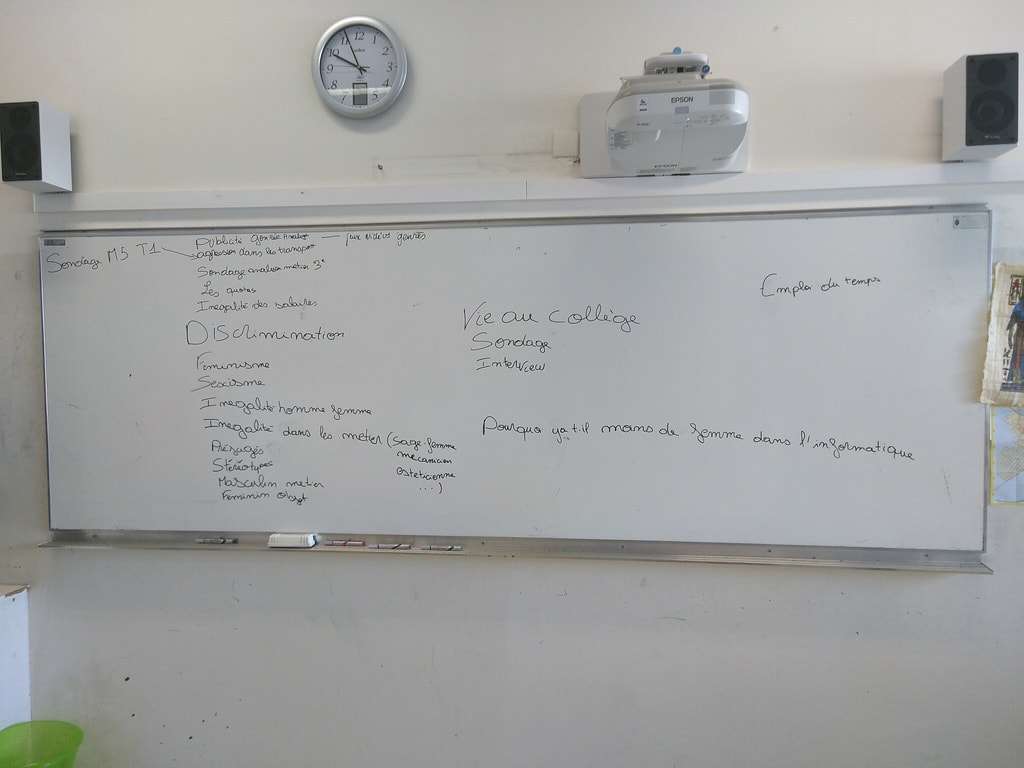
Questions were raised and we now have a list of article ideas for the newspaper:
- List of masculine job titles whose feminine form is the name of an object
- Survey of the 9th graders -> What jobs do they want to do later?
- Survey on the M5 and T1 lines about harassment on public transport
- Comparing jobs at the school / comparing pay between men and women
- Why are there fewer women in computing?
- Comparing work / leisure schedules by gender (what boys and girls do after school)
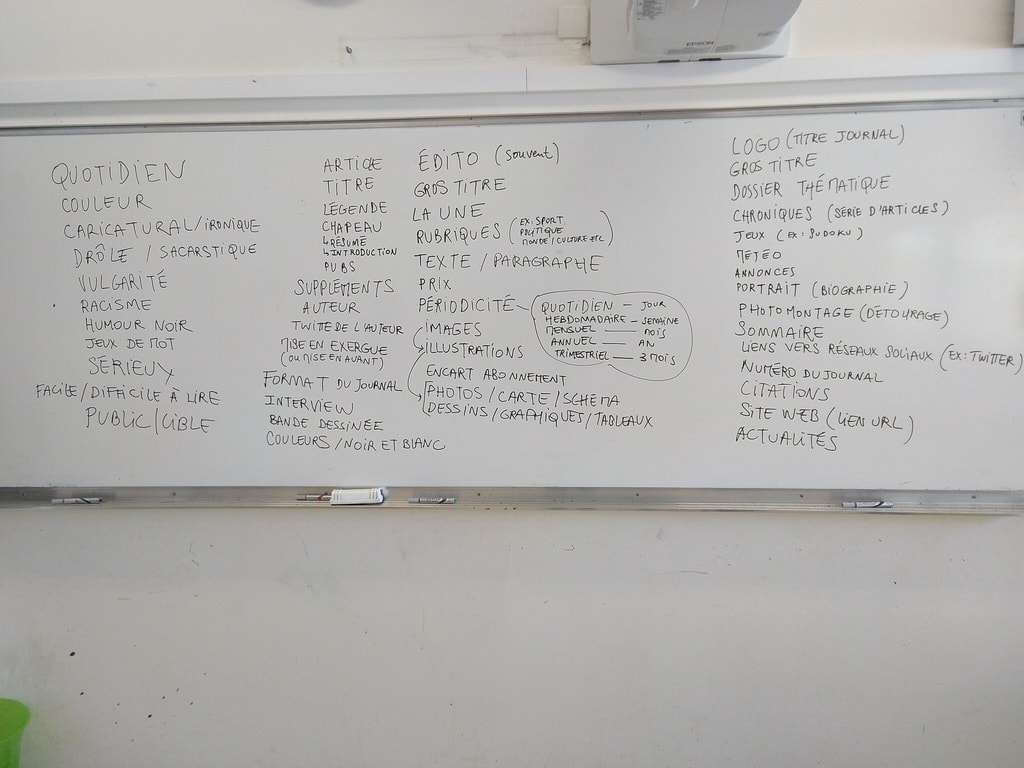
We then move on to analyzing newspapers: I bought a sample of newspapers to analyze in groups: Libération, Le Monde, Le Parisien, L'Équipe, Le Canard Enchaîné, Charlie Hebdo. Of course everyone wants L'Équipe (the sports newspaper). The idea is to analyze the structure of a newspaper: what types of content are there? What never changes? How are they laid out?
From these questions and the students’ analysis, we build a glossary:
Content
- Title
- Article
- text
- paragraph
- Image caption
- Standfirst = summary, introduction, between the title and the beginning of the article
- Author and the author’s Twitter
- Interview
- Comic strip
- Editorial
- Headline
- Front page = the first page of the newspaper
- Back page = the last page of the newspaper
- Sections (for example: sports, politics, world, culture)
- Price
- Frequency
- daily = once a day
- weekly = once a week
- monthly = once a month
- quarterly = once every 3 months
- yearly = once a year
- Images / Illustrations = photos, photomontages, maps, diagrams, drawings, charts, tables
- Logo (or newspaper title)
- Special report
- Columns = series of articles spanning several issues
- Games (for example: Sudoku)
- Subscription box
- Weather
- Classified ads
- Profile = biography
- Table of contents
- Link to social networks (e.g. Twitter)
- Issue number
- Quotes
- Website
- News
- Advertising
Layout
- Highlighting some sentences = pull quotes
- Newspaper format
- Themed supplements
- Color / black and white
- Columns
- Cut-out photo = digitally cutting out an element of a photo
Tone of the newspaper
- Caricatural
- Ironic
- Funny
- Sarcastic
- Vulgar
- Racism
- Black humor
- Puns
- Serious
- Easy / Hard to read
- Target audience = who the newspaper is for (e.g. teenagers, children, adults, everyone…)
Editorial meeting
Wednesday September 26th, 2018, Bobigny
Second session of this workshop: we will have to make shared decisions about the features of the newspaper we are going to make together. We also need to refine the choice of articles and form the working groups.
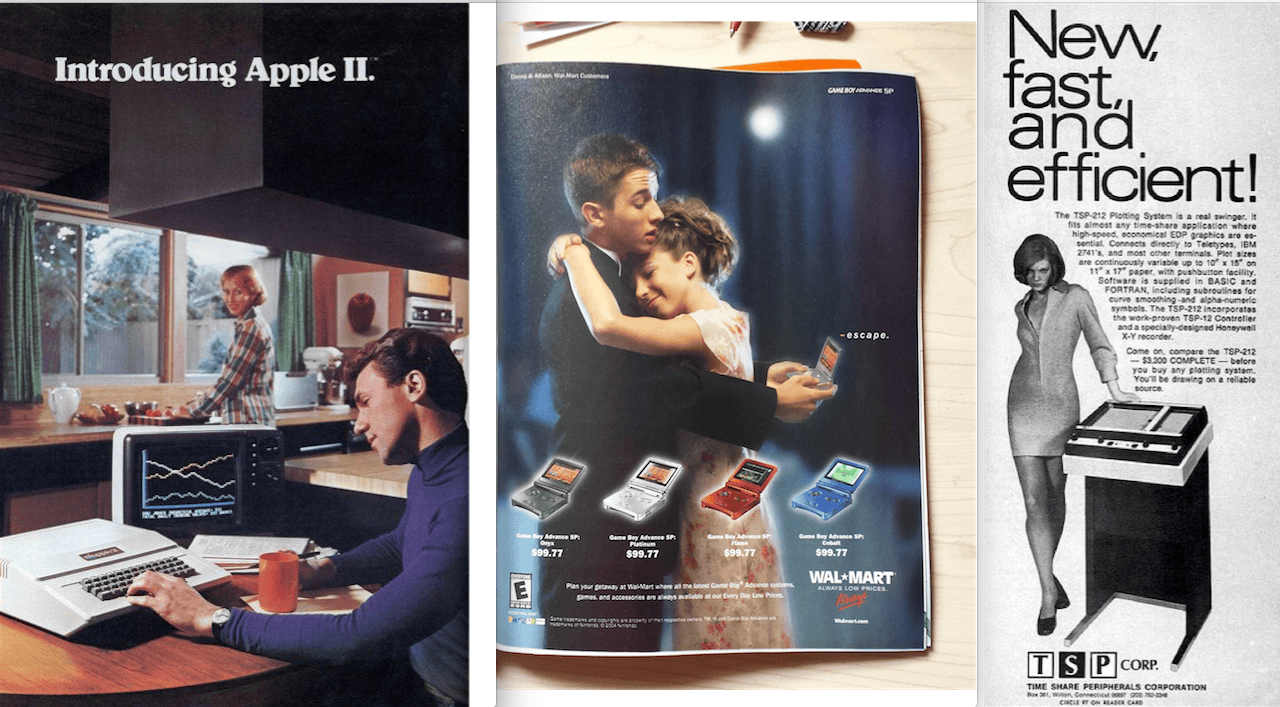
I decided to start this 4-hour session with an image analysis. I selected images from Marie Lechner’s collection of women and computers ads; she is the curator of the Computer Grrrls exhibition. During the last debate, I had asked a student to act as a moderator, give the floor and ask questions to clarify the students’ remarks. It had worked rather well (and I realize while writing this report that I forgot to mention it in the previous one). So I suggest doing it again, and a student volunteers to moderate the discussion. We analyze the chosen ads; most of them are in English, so it is a translation workshop at the same time. The analysis clearly shows that men / boys are presented as able to use computers, while women are relegated to the background in this field (usually as mothers or wives). It all starts to make sense in the students’ minds, especially the girls’.
After a good discussion about these images, we move on to a more hands-on activity. I show them how to make a research notebook: a few white sheets, slightly thicker colored sheets for the cover and a long-arm stapler. Everyone folds, but the stapling scares them and I usually end up doing it for them.
It’s time for the editorial meeting; we need to agree on several points.
– Who are we making this newspaper for?
– For everyooone!
– Boys and girls!
– How are we going to distribute the newspaper?
– For free!
– No, we could sell it and make some money!
I step in:
– The project is funded by the Gaîté Lyrique, it wouldn’t be very fair to sell it, would it?
We all agree on making it free.
– We’ll hand it out at the train station and in the metro!
– And in the mailboxes of our buildings.
– (The boys insisting on the fantasy of the American paperboy) By bike, we’ll put them in the mailboxes!
– At school, to the teachers, to the students.
– OK for distribution. And how many copies do we print?
– 10,000!
– 50,000!
– OK, OK! Well, let’s not throw out random numbers. Get into groups and let’s think about a sensible figure.
Out come the calculators and we pool the proposals:
- 3,000 copies… (and why not?)
- 25,000 copies (half of the inhabitants of Bobigny)
- 93,000 copies (Bobigny’s postcode)
- 1,100 copies (50 newspapers to hand out per student)
We have a budget of 1,500 euros, so we go for 1,100 copies, which seems the most reasonable figure (“yes, but we can make 25,000, we’ll hand them out by bike!”)
– OK, that’s all very well, but what do we call our newspaper?
– Le JPT (for Jean-Pierre Timbaud)
– Les Boboch
– Le wesh Boboch
– Le Journal Pour Tou.te.s (The Newspaper For Everyone, which is also JPT, clever!)
Big enthusiasm from part of the class. Then Romain asks Valeriu, a student unable to speak up in front of everyone:
– And you Valeriu, what would you call your newspaper?
Valeriu answers “Chépa” (slang for “I dunno”, apparently his answer to any question). Romain bounces off it:
– Oh yes! We could call it Chépa. You say that all the time, and it could be a principle of the newspaper: questions you try to answer.
The class and I are excited. But some still prefer Le Journal pour tou.te.s. We vote and the majority goes to Chépa. As the disagreement continues, I suggest calling it Chépa, Le journal pour tou.te.s. Proposal accepted!
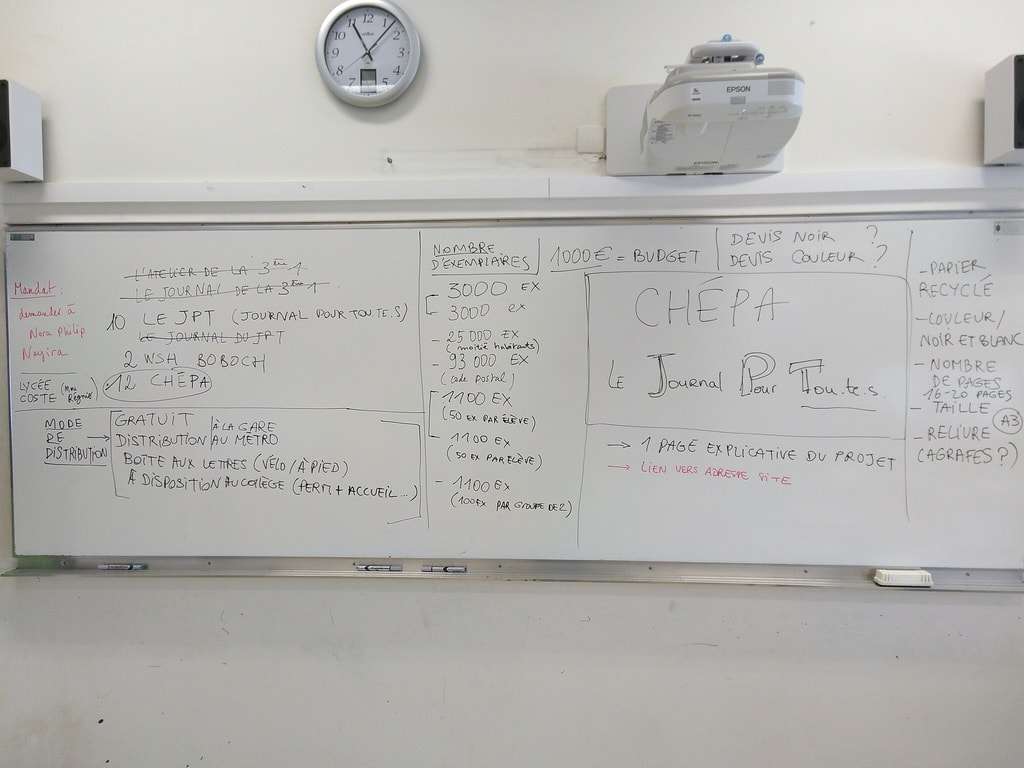
To ask printers for a quote to estimate the budget and the number of possible copies, we need to decide on a few properties: paper, color, number of pages, format, binding… We first go for a classic finish: recycled paper, color, 16 pages, A3, folded unbound signature.
We made progress on the form.
Let’s move on to the content.

We go back over the topics chosen last time. A student moderates while I take notes on the board. 3 themes come out of the discussion: men / women at work, the representation of girls in video games, and harassment on public transport. So 3 groups are formed: 1 group of boys (5 students), 1 group of girls (6 students) and 1 large mixed group (9 students).
A few article ideas start to emerge:
- Career guidance / imagining oneself in a profession
- Survey of the 9th graders -> “What do you want to do later?”
- Comparing men and women
- The representation of girls in video games
- Girls are under-represented
- Analysis of various video games (Tomb Raider, GTA…)
- Harassment on public transport
- Survey of passengers
- Racist insults
- Stares
- Verbal attacks
- Men rubbing up against women
- Remarks about women’s clothing
- Self-defense
- Witnesses
(Janushan told his story about being insulted on public transport again and again, of course)
We part with all these discussions in mind. Next workshop next week, to start researching and writing the articles.
Researching and writing the articles
Wednesday October 10th, 2018, Bobigny
First, we list the remaining tasks:
- Research information (books, internet)
- Write the articles on the computer
- Give the articles a title
- Add the date and author
- Choose the images
- Photo credits
- Sources of the images and articles
- Order the topics by theme (make the flatplan)
- Table of contents - Think about the front page
- Layout (position of texts and images)
- Printing
- Distribution
Then we went to the computer room so the students could start researching their articles. They split into groups; I wanted them to organize themselves within each group by sharing the tasks. It didn’t really work.
The group working on harassment started building a database by looking for testimonies, especially in the Île-de-France region. They also watched bus surveillance videos.
The group working on girls in video games chose several example games. In two subgroups, they analyzed the representation of women by choosing images to illustrate their point. The third subgroup did more general research.
Three subgroups as well for the research on gender equality at work: - 1 group looking for images of jobs to analyze them later (gendered jobs?)
- 1 group writing the survey questions (what do you want to do later?)
- 1 group writing an introduction to this survey
There were some minor disagreements within this group.
Working groups
Harassment in public spaces
Dina, Foued, Lecky, Lyna, Yann, Oumar, Norhene, Janushan
Survey - 9th grade career guidance - gender equality
Noraya, Christelle, Ambre, Sonia, Najira, Douna, Diaretane
Girls in video games
Ludovic, Valeriu, Harzan, François, Daniel, Amire
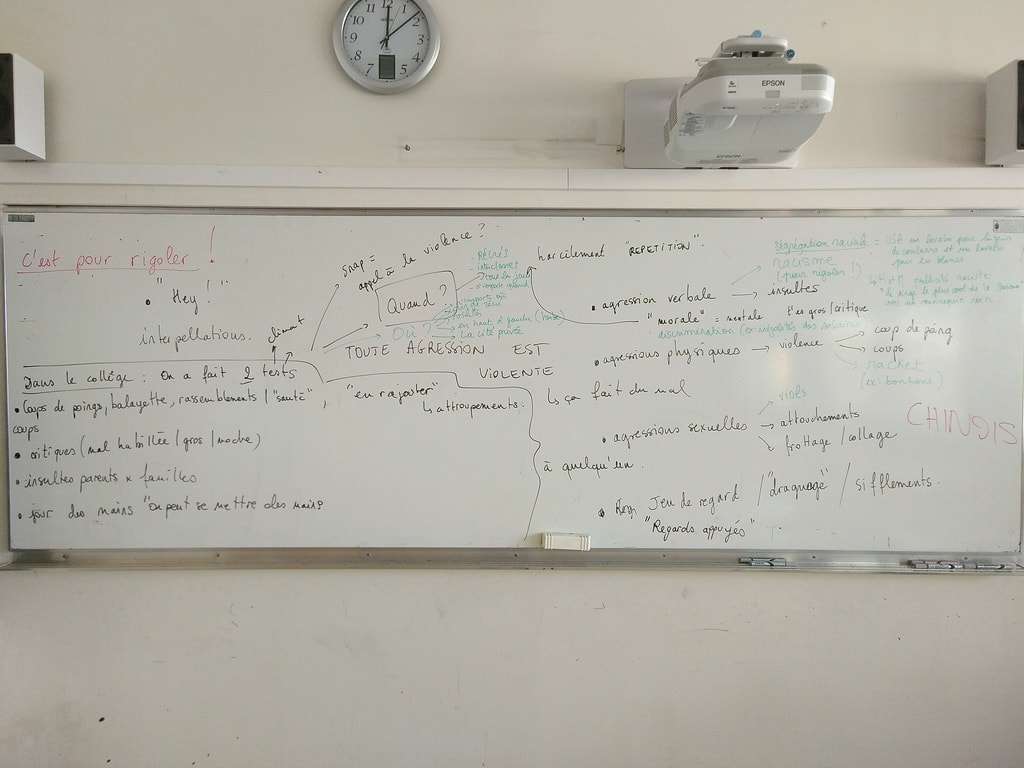
At the 11am class change, we go back to the classroom. Several incidents happen: fights in the hallways, and someone writes “Chinese” in big letters on the board.
We start a discussion / debate with the students about harassment and violence at school. It is not normal that, after working on this topic all morning, they reproduce the very things they criticize. Here is a summary of this discussion.
Any aggression is violent
Defining the types of aggression in general:
- verbal aggression
- insults
- psychological aggression = mental, bullying (repetition), criticism (e.g. you’re fat)
- discrimination
- racial segregation, racism.
- Example: in the USA, there used to be sinks for Black people and sinks for white people
- Example 2: a racist H&M ad: a Black child model wearing a sweater reading “coolest monkey in the jungle”
- physical aggression
- violence
- punches
- kicks
- blows
- racketeering
- sexual aggression
- rape
- groping
- rubbing up against someone
- staring (insistent looks)
- unwanted flirting
- catcalling
What kinds of aggression at school?
- Physical violence
- Punches
- leg sweeps
- gatherings
- group fights, “jumping” someone
- Criticism (badly dressed, fat, ugly)
- Insulting parents and family
- Racist insults (dirty Arab, dirty Black)
- Hand games (the day when everyone slaps each other’s butt)
- someone launches “hand day” on Snapchat and everyone has to slap everyone’s butt at school
- Candy racketeering
When?
- Breaks
- Class changes
- Every day (except Friday at 3pm)
Where?
- Anywhere
- Playground
- In the courtyard, top left (near the grass)
Why?
IT’S JUST FOR FUN!
The students are shocked when they are attacked outside school by people they don’t know (mostly insults). But for the same aggressions inside the school and by their classmates, no problem: it’s just for fun.
Writing and flatplan
Wednesday November 7th, 2018, Bobigny
On this rainy day, with a fire on the highway, Romain and I arrive about ten minutes late.
The students were seated in rows in the computer room.
We haven’t seen each other for three weeks; it’s the first session after the holidays. In the last session, the students started writing their articles, then we had a debate about aggression at school.
Today, I first ask them to present their work in progress orally. They have to log into their session, project the article they are writing and talk about it to the others. Computer problems: Windows Vista, very slow, it takes a while to get started.
The first group to present works on harassment on public transport: they collected testimonies found on the internet, made hypotheses and some observations, found figures and started surveying the other students: have they ever been attacked? What do they think about it? What are their prejudices about aggression?
It is all a bit messy and not very well structured. I notice that speaking in front of others is hard for them and that they are unable to summarize their work: they have to read to talk about it.
We list what they still have to do.
It’s the second group’s turn, working on the representation of girls in video games. It is hard to get them to speak; they read their text.
The third group, on gendered jobs, is more organized. They wrote an introduction, an observation and precise questions for their survey, and started looking for illustrations. They now have to survey the students.
But none of them managed to summarize; they all read.
Romain tells me they rarely present orally and usually read, even though they will have an oral exam for their brevet (end of middle school exam).
The students then go back to the computers to keep writing their articles. Little concentration, lots of unrelated YouTube, they progress very slowly. We have to guide them to make them do what they are asked. They seem lost when given few instructions.
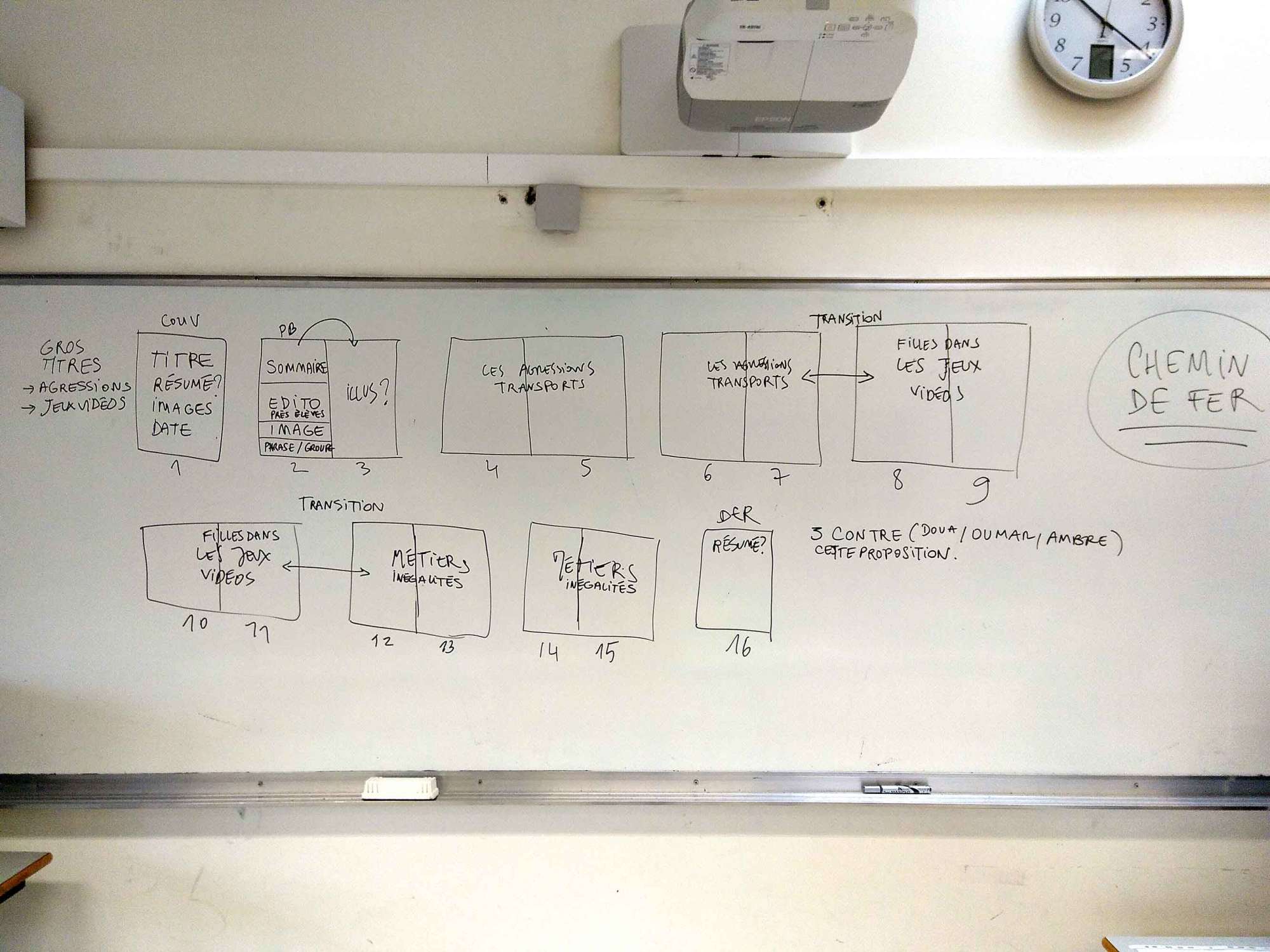
For the last half hour, I suggest an editorial meeting to set the flatplan. Leiki offers to help me lead the discussion and takes on the role of moderator.
What do we put on the cover? Debates heat up, and so does the trolling. It’s long, too long. We try to make shared decisions; it is quite hard to reach consensus. The students are restless, and some listen and pay less attention. Leiki takes her role seriously, giving the floor and calling for silence when needed.
We need to find an order for the articles. At first, each group wants its article first: first is best. I had to get them to argue for their choices. Often it’s a yes or a no without a “because”. Little by little, students who rarely speak start giving their opinion, the most unruly ones listen and stop interrupting, arguments come. There are disagreements and some suggest compromises. In the end, we manage to define a flatplan that is not set in stone.
Photography workshop with Frédéric Danos
Wednesday November 21st, 2018, Bobigny
On the way to Bobigny, I tell Frédéric the anecdote about the differences between girls’ and boys’ after-school schedules: girls doing household chores, boys playing video games.
We arrive in the classroom with Frédéric; the students seem restless. A “yo mama” is thrown out, and someone replies “Leave his mother alone, she has nothing to do with it”.
We ask the students to present their articles and progress so Frédéric can catch up. Janushan starts and presents his group’s PowerPoint on harassment on public transport. They made a table of contents with the different articles on their theme. But not everything is finished yet. He easily explains the group’s question, their ideas and what they still have to do.
It’s the turn of the group on jobs. One of the working documents seems to have been lost in the depths of the computer. “It wasn’t me, it was the machine.”
Each presentation is complicated: the students have to find which session they saved their work in, log out, log back into Windows Vista; it’s long and tedious.
The group working on jobs conducted nearly 50 surveys of students and adults. Students were asked forward-looking questions (what do you want to do later?), while adults were asked rather biographical questions: “what is your job? What did you want to do when you were in 9th grade?” Now they need to analyze them. Romain suggests comparing what adults wanted with what actually happened.
The video games group goes next; they can’t find the new articles they wrote because François is absent and everything is in his session. A recurring problem. In this “digital pilot” school, nothing is set up for group work: only individual work and grades count.
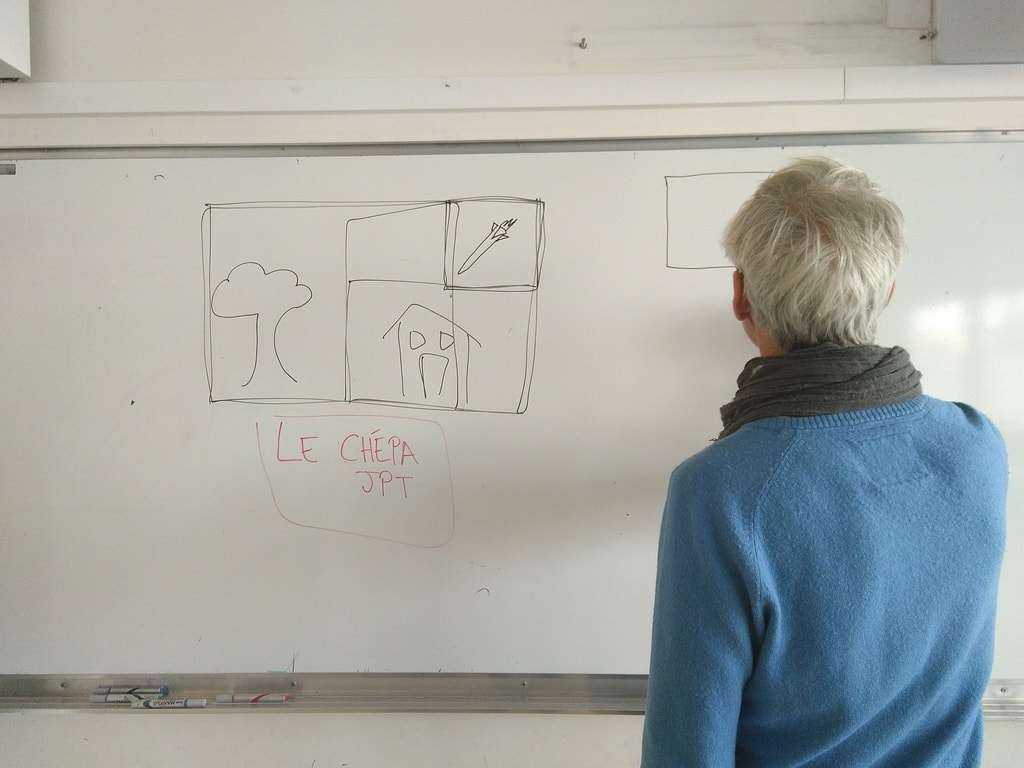
We then start a discussion about framing, the meaning of images and their captions. Frédéric explains what cropping is and how it can transform an image. We then show them a series of images we cropped, asking them what they see and what the image tells. We end with a Robert Capa image from World War II. Frédéric cropped it so that we only see a group of people walking and a policeman turning around with a smile.
We ask the students to date this image and tell us what is happening. They find it hard to date: black and white gives them a clue, but they are still way off. They talk about demonstrations, maybe a prisoner? People look happy.
Finally we show them the whole image. A woman with a shaved head, carrying a baby in her arms, is being led away by a policeman. We ask them to date the image again. We talk about the skirts, the policeman’s kepi, the date photography was invented. Finally we give it away: this image dates from 1945.
So what is happening? They talk about concentration camps:
- The woman looks very thin, maybe she just got out of the camps?
- Or maybe she fought in the war?
- But what is the policeman doing? Why is her head shaved? What does she have on her forehead?
We end up explaining that in 1945, women suspected of collaborating had their heads shaved. Some had had a love affair with a German soldier, some had been active in the militia, others were scapegoats. Once shaved, a swastika was drawn on their forehead and they were paraded through the streets before being shot.
It’s break time; the second part of the workshop will be dedicated to practice: taking photos. Back from the break, Frédéric lists the different types of possible photos: context, illustration and metaphor. For example, for an article on harassment on public transport, a context photo could be a photo of a metro platform; the illustration photo would show someone having their bag stolen; and the metaphor photo, always harder to give an example of, is one thing standing for another.
The students gather in groups in the classroom; they have 20 minutes to decide which photos they will take during one hour. Constraint: they can’t leave the school. The group on harassment on public transport wants to stage scenes, the group on jobs will photograph the different staff of the school, and the video games group decides to stage scenes in the computer room. And off they go, all groups set out on an expedition through the school, smartphones in hand. Lucie (project coordinator at the Gaîté Lyrique), who arrived in the meantime, takes charge of the video games group. Frédéric goes to the school lobby with the group on harassment on public transport, I try to follow the jobs group, which scatters around the school, and Anne goes around the projects.
I find some of the girls from the jobs group trying to persuade the janitor to let them take his photo; he doesn’t agree, but they find an alternative: photographing the broom with the trash, and there you go, a good photo!
They face a lot of refusals. I then find them in the office of the deputy head, who among other things handles the accounts. Nobody knows what her job is, so she explains it before letting them take her photo.
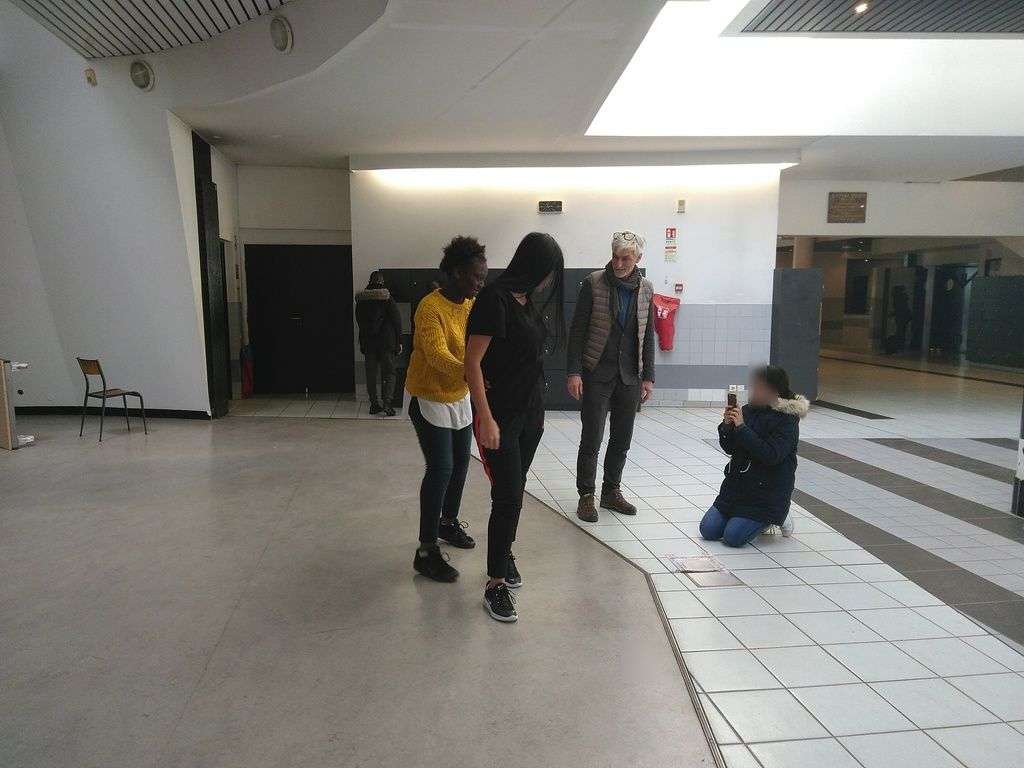
Meanwhile, Frédéric helps stage the scenes of harassment on public transport: bag theft, phone theft, groping, everything. In turn, the students are actors, extras or photographers.
I go up to the computer room: a big staged scene, with video game images on the computer screens, very effective.
Time to go back to class and look at the photos.
Some lag, a mess: we try to gather all the photos on my computer to project them. The cable doesn’t work, impossible to transfer photos from iPhones, thanks Apple, as usual. We try sending them by email; it’s complicated. Once again, I should have set up dodoc, it would have been much faster; we are wasting time here.
We end up managing, partially. We debrief the photos: the good points, the bad points, what needs to be redone. Watch out for the light, some rather static scenes, a lack of context, but overall good photos that are perfectly usable.
Fablab workshop, building dodoc
Wednesday December 5th, 2018, Carrefour du Numérique, Paris 19
A rather special workshop: we left the classroom and the school to go to the Carrefour du Numérique, on level -1 of the Cité des Sciences, where there is a very nice fablab. The workshop was organized with Thierry, who welcomes us this December morning. I introduce the fablab: what is it? What do people do there?
We are going to build the dodoc documentation station there, using the laser cutter, the vinyl cutter and the soldering stations.
Each group has one part of the station to make, with a series of instructions to follow: the dodoc box, the support box with its storage drawer, and stickers to decorate the box. Lyna, Leiki and Janushan take the photos.
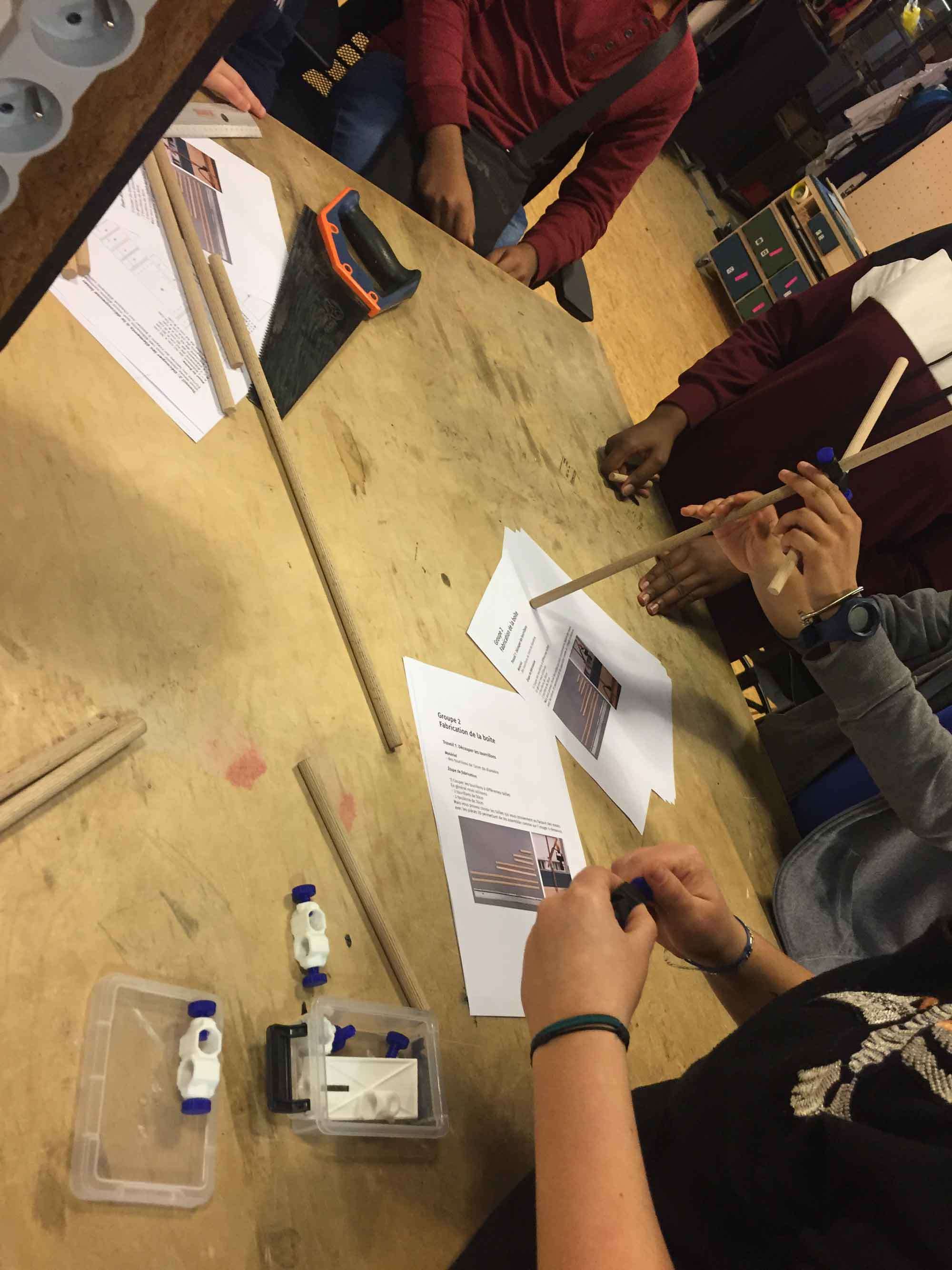
Each group reads its instructions and prepares the materials it needs. Meanwhile, we prepare the laser cutter, which will cut the various parts of the dodoc box and the support box. In small groups, the students come to have the machine explained and watch the laser precisely cutting the MDF sheets.
They all thought the laser cutter was a kind of pen sending out a laser that cuts as you draw; they are very surprised to find out it is driven by a computer.
Once the cutting is done, the groups get busy.
The “dodoc box” group solders, builds the Arduino circuit and assembles the various parts. They finish quite quickly and it works.

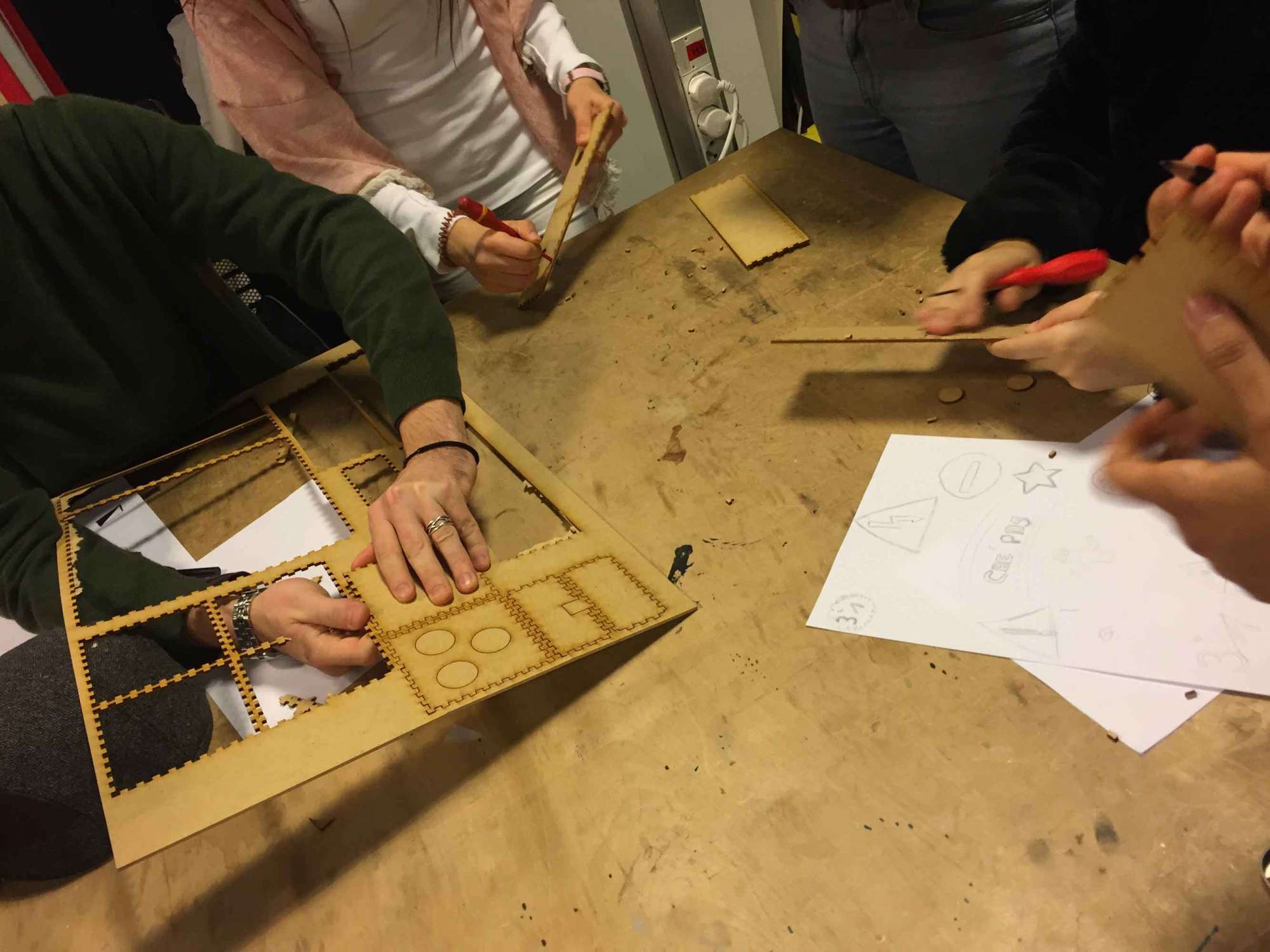
The “support box” group is busy assembling the parts, gluing and hitting with the mallet to fit the pieces into each other. Some parts are slightly misaligned; they try to find a solution. In the end, the box is great.

The last group draws the stickers by hand, then redraws them in the software used for vinyl cutting, to cut out stickers. A few small problems with the vinyl cutter: we don’t know it well, and it takes us a few minutes to understand how it works. After a few size tests, they produce a newspaper sticker and a 3ème1 sticker. With the class’s consent, they stick the stickers on the box and put away the equipment: camera, 3D parts and dodoc box in the drawer designed for this purpose.
3 hours of building, and the dodoc station is ready to be taken back to the school and used in room 206.
Photography workshop in Bobigny
Wednesday December 19th, 2018, Bobigny
A cold winter Wednesday morning: we planned to go out with the students to take / retake photos in the town. We start by looking at the photos taken a month earlier during the workshop led by Frédéric Danos. Which photos should we keep? Which ones should be retaken?
The groups quickly decide on their plan of attack.
We all walk together towards Pablo Picasso, about twenty minutes away. There we split into two groups: one group heads to the metro to restage the scenes in a real setting, and with the other group we walk around the neighborhood looking for people at work. We meet two men, gardeners for the town of Bobigny. After a clumsy explanation of the project by a student, the gardeners refuse to be photographed; they don’t seem to have understood the project. We then go to the shopping mall, but it’s not even 9am and most shops are closed. The group tries to approach a woman who, on the defensive, tells us that taking photos in the mall is forbidden. We carry on anyway. A butcher’s shop is open; one of the students volunteers, plucks up her courage and walks up to the counter to explain the newspaper. Every time, it’s the same thing and they ask me: “but what should I say?”. We go over together the things they mustn’t forget to mention: Jean-Pierre Timbaud middle school, a class project, we are making a newspaper about inequality between men and women and we are working on an article about inequality at work. Some information often gets skipped. The butchers are very welcoming. They know the school well and let themselves be photographed while working.
We go back to the meeting point; the other group staged scenes of harassment on the metro platforms, quite successfully.
Once everyone is back together, we return to the school by tram.
Computer room, a tiny one: the goal is to sort, select and retouch the photos taken; cropping and adjusting the brightness are a must. They are not really used to handling files and folders on a computer: how do you create a folder? How do you copy and paste? Which software do I use for retouching? We use Gimp, a free image editing software. I go around all the groups, explaining and showing them various operations.
We end up with a selection of photos for each group, which everyone neatly stores in a shared folder.
Next time, we will gather the content in dodoc!
Getting started with do.doc
Wednesday January 9th, 2019, Bobigny
This Wednesday morning, we only have two hours for the workshop, which is not a bad thing: 4 hours is often long and the last hour is not very productive. Last time, the flatplan was debated and some points are still unclear. I suggest a meeting to set the flatplan. That morning, for the first time, I am alone with the students: Romain is on sick leave for a month after breaking both hands, and Anne has to look after some of Romain’s students. They are very restless and unfocused; it is hard to discuss the flatplan together. They don’t feel like it, I can see it’s not working, we make decisions quickly, I suggest things and they say yes to everything. We rush through this part. Faced with their lack of involvement, I ask them “Are you bored with what we’re doing together?” They all answer “Noooooo” in chorus, except Lyna: “Yes, it’s always the same thing”. An interesting remark.
Quick, another activity: we move on to getting started with do.doc. In small groups, according to their theme, they spread out over the old Windows computers of the computer room. I show them how dodoc works: how to add photos to their folder, create text and lay out their article. They pick it up quickly. Since it is impossible to use dodoc over the network because of a firewall, and the computers can’t be connected to Wi-Fi, we don’t use dodoc’s content sharing feature. Everyone has their own dodoc, which creates many constraints. How am I going to gather the content to collect it and assemble the pages of the newspaper?
They import their illustrations into dodoc: it’s slow, it lags, it bugs, everything stops, freezes, shuts down… a bad day. It is hard to keep them focused when the equipment can’t keep up. Lyna gets annoyed, fed up, and tells me “Honestly, we’re supposed to be a digital pilot school, have you seen the equipment we have? Nothing works, and they’ve been promising us tablets for over a year”; she has a point. We calm down, refocus, it’s going to work.
In the end, they all manage to import their files; they also copy and paste their articles into dodoc’s text editor and format their text: italics, bold, headings, etc. They are ready to start the layout. That will be for the next session; the two hours are over.
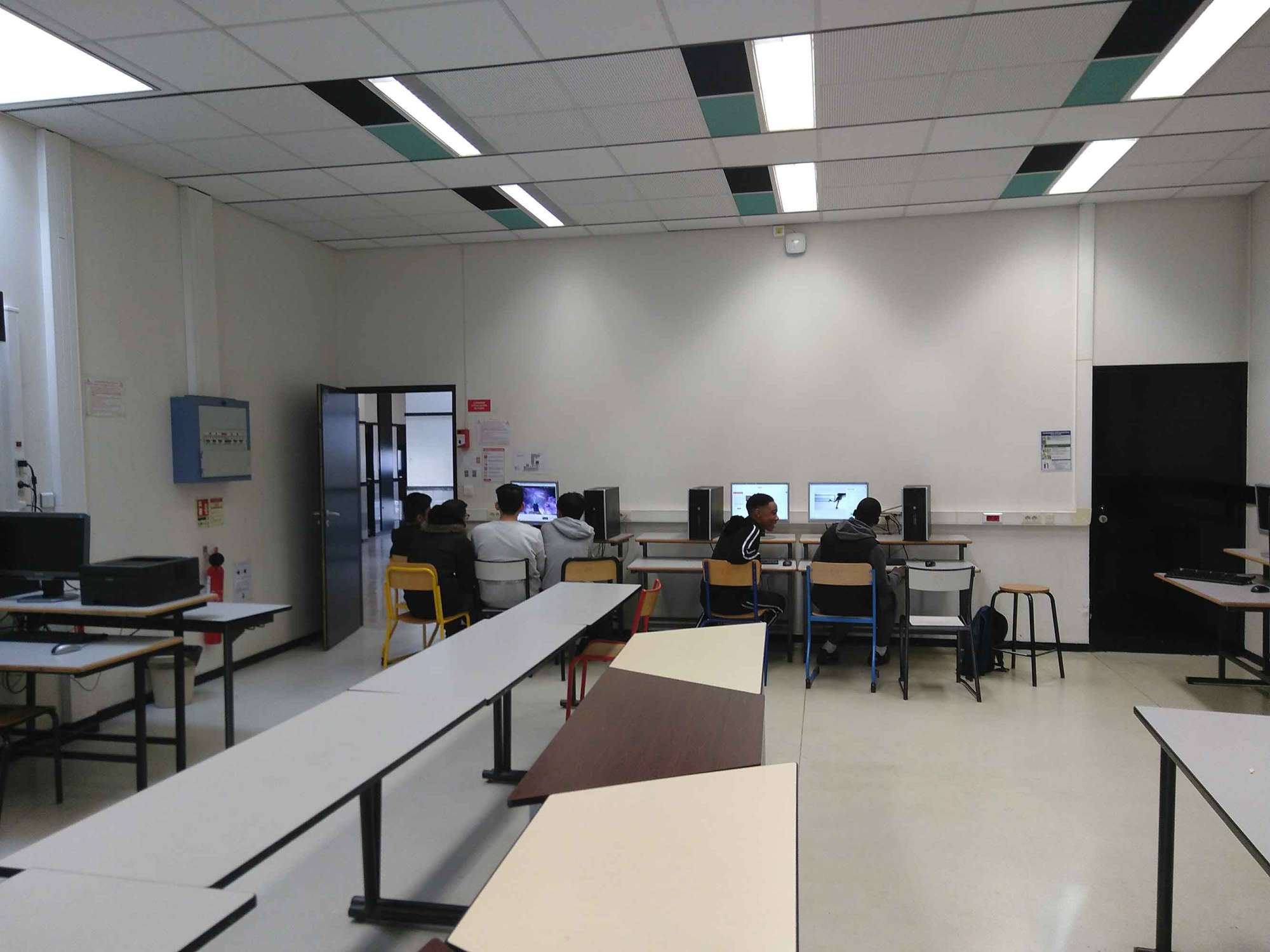
Laying out the articles
Wednesday January 23rd, 2019, Bobigny
Few sessions are left. For printing the newspaper, we had a lead with the Coste vocational high school, which offers a printing diploma; unfortunately it won’t happen. I suggest printing the newspaper with Newspaper Club, a British company that prints on the Times’ presses. That way we will have a 16-page newspaper in 1,000 copies on 70 g paper, in color, tabloid format (289 mm x 380 mm). The students agree and are delighted. Today the plan is simple:
- laying out the articles: the articles were proofread beforehand by Anne and must include a title, the authors, the illustrations, the captions and the credits.
- checking the layout and the last mistakes with the teachers
- signing up to take charge of a shared page of the newspaper: the front page, the editorial, the credits, the games
The students get down to the layout seriously; it’s quick and intuitive, and strangely today everything works. The sign-up system for sharing the common tasks works wonderfully, and by the end of the session we have a first draft of the newspaper.
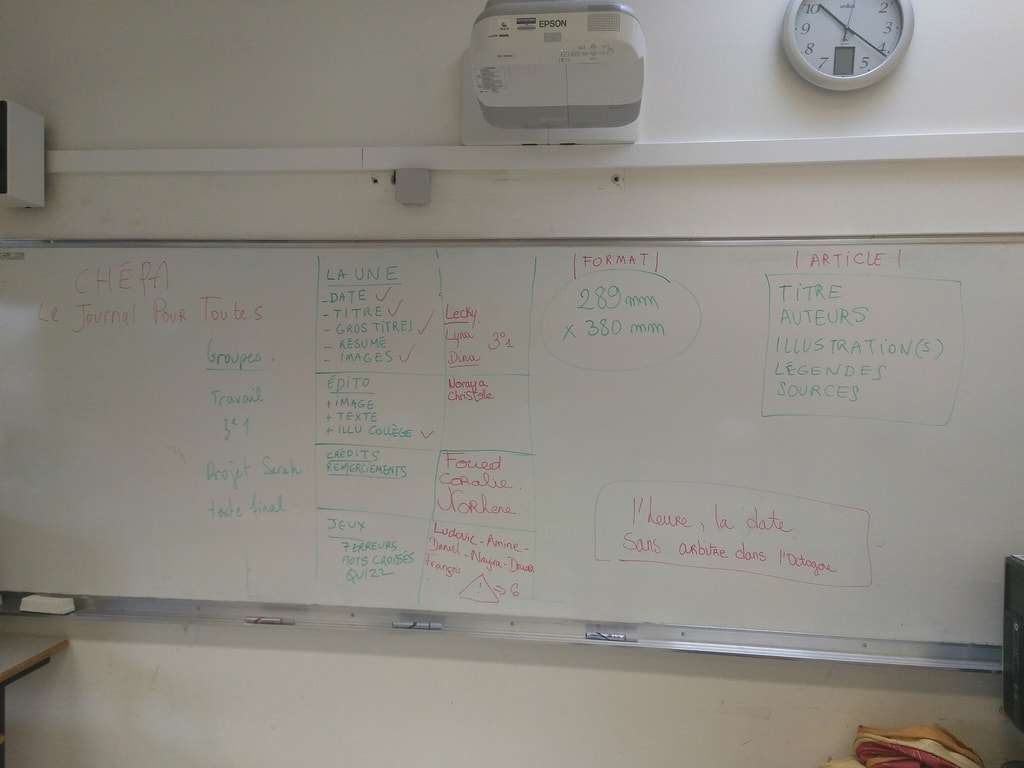
Since the computers are networked, I ask the students to copy the publication folders and content folders into a shared folder. I can then copy and paste everything into my dodoc, check the articles and reorganize the pages according to the agreed flatplan.
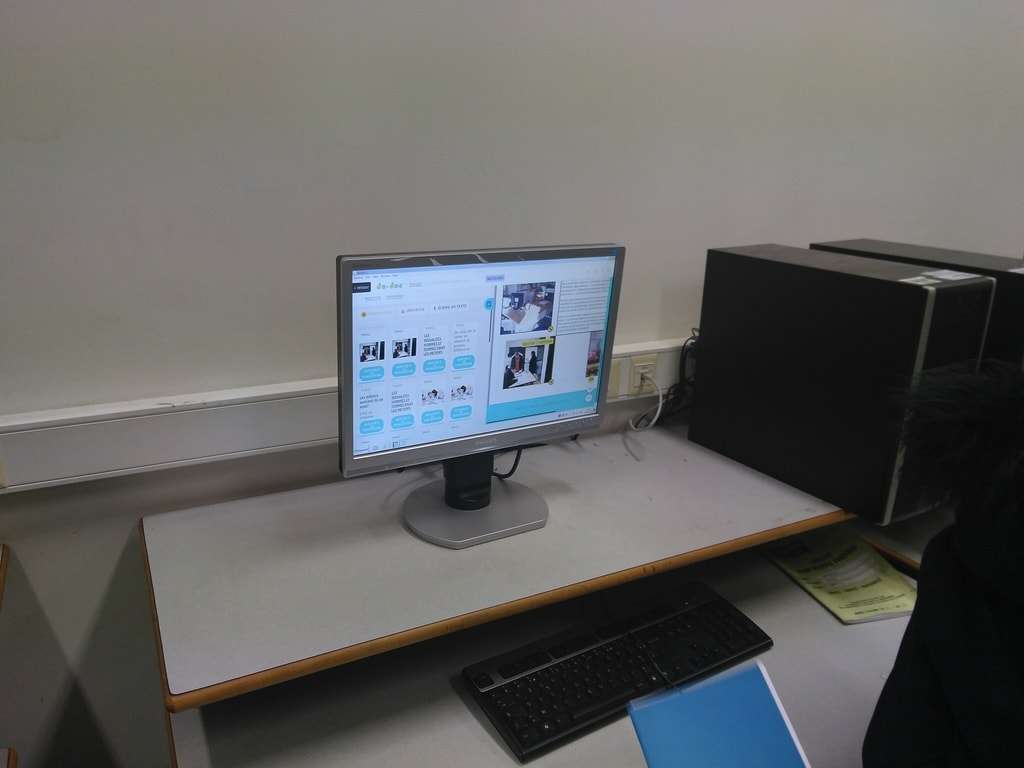
Later, while preparing the next session, the folders and publications do show up in my dodoc. I first decide to export each publication as a PDF one by one, then put them together to make corrections. I proofread the whole newspaper and add comments and corrections on the PDF. I realize that most of the credits and captions are missing, and that 2 articles are missing entirely…
2 adults for 22 students is not enough to properly supervise such an activity.
Stop-motion for the online version
Wednesday January 30th, 2019, Bobigny
We are slowly approaching the end of the workshop and the newspaper is almost ready to print. I compiled a first version of the newspaper, proofread it and shared my notes on a PDF. Each group gets the file from the intranet. I give an overview of the corrections: a few spelling mistakes, sentences to rephrase, clichés and platitudes here and there to change, and above all image captions and credits to complete. We insist on the importance of finding the sources of images; the students grumble a bit about this tedious exercise, then get to work. [note: later, Anne will tell me that during the mock brevet exam, one of the students cited the source of an image he presented]
According to the flatplan, two pages are still blank: one for a “Video games” article, the other for an article about jobs.
The article on the video game League of Legends is ready; the group hadn’t added it to the mock-up. The jobs group, however, has to fill a gap. So they decide to include the survey results in a summarized form. Everyone knows what they have to do, between corrections and finishing the articles.
For his part, Ludovic finishes the spot-the-difference game he designed on Lara Croft with GIMP. He has figured out how to erase parts of the image and is having a blast.
Once the print version is finished, we tackle the content for the online version.
I set up the dodoc station built by the students and suggest that some groups come up with stop-motion animations. The group on harassment on public transport decides to make stop-motions of the various kinds of harassment listed in their articles. We move the dodoc station to the hallway to have some space. The two actors get into position to simulate a phone theft on a metro platform, while another student stands behind the station to quickly press the dodoc box and take lots of photos during the action.
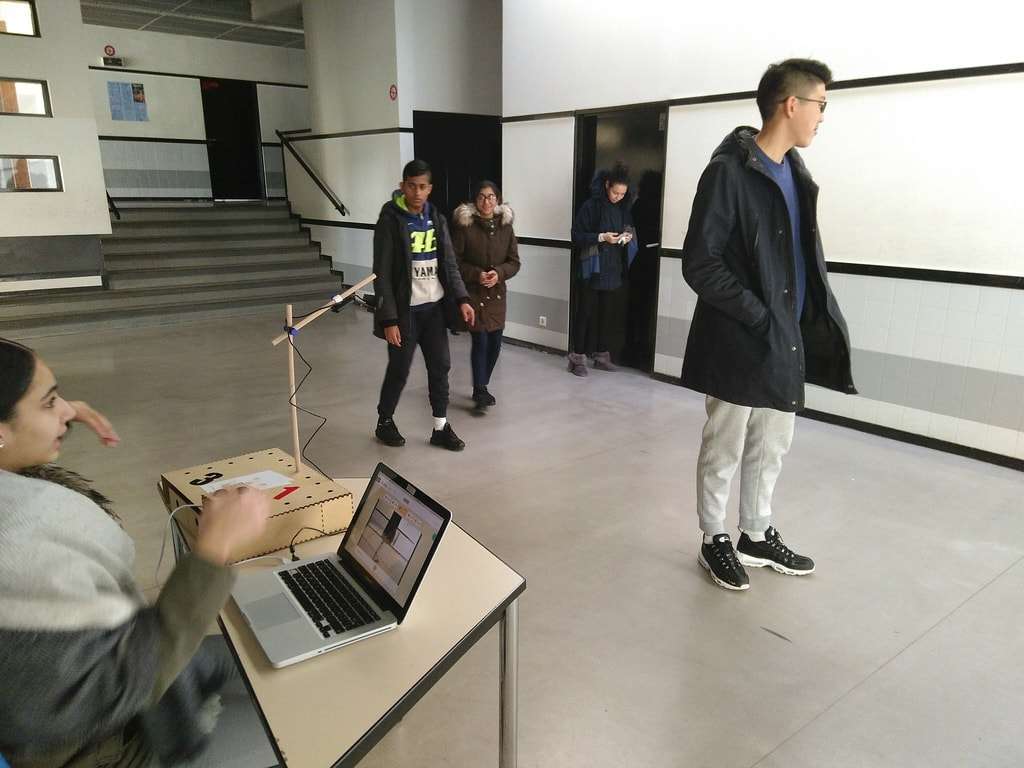
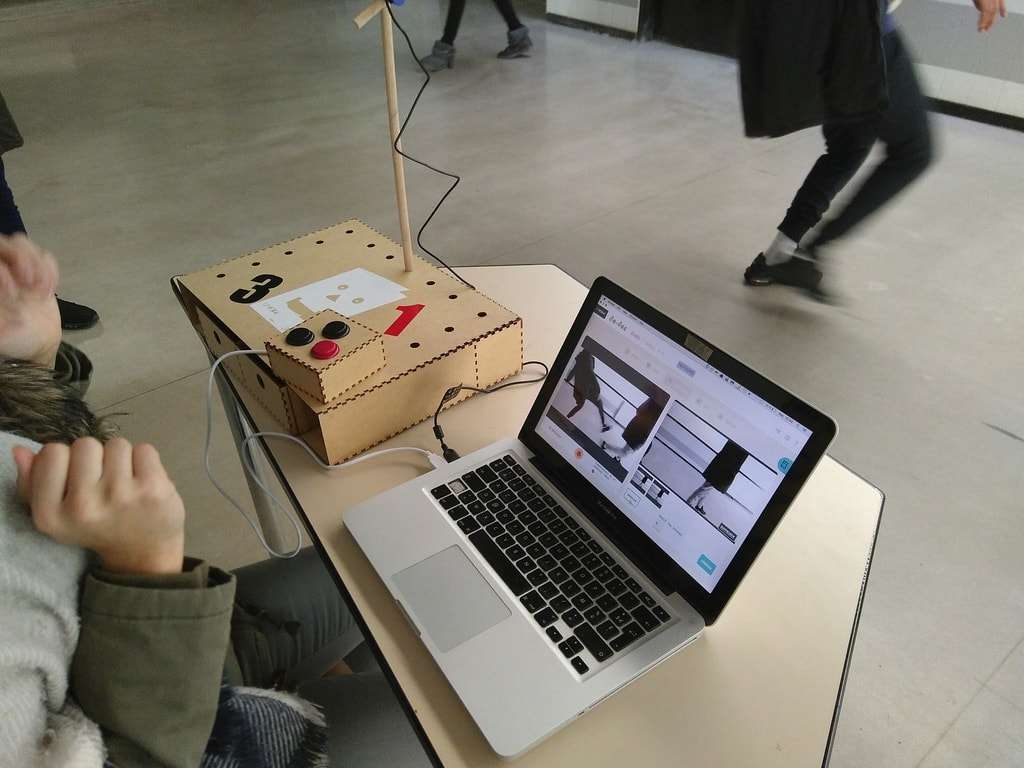
Several short stop-motions are made this way. Meanwhile, other students draw and make animations illustrating their articles for the web version. The video games group searches YouTube for videos showing prostitution in GTA5. But they can’t access them because the content is restricted to over-18s. I ask them what happens in the game when you pay a prostitute. They answer that they don’t really know, they’ve never done it: “it’s too gross”. Apparently, you see a girl shaking her butt in front of you and you can perform several actions on her. The session ends, and this group mostly slacked off watching videos…
Laying out the online version and editorial committee
Wednesday March 20th, 2019, Bobigny
Two months have passed since the previous workshop. Between my various projects, Romain’s sick leave and the February holidays, the last four hours were hard to schedule.
On the program of this short 2-hour session: proofreading of the newspaper by an editorial committee, and finishing the layout of the online version. I hand out to all the students the current version of the newspaper, printed on A4. They find it hard to picture the sizes of images and texts at the right format and keep finding it “too small”. I give them time to read and discover the newspaper as a whole, and the other groups’ work in detail. Lyna and Leiki think some things are not right and offer to take care of the editorial committee. Everyone agrees. The other students all have small things to finish: games, the layout of the online newspaper, or corrections.
The editorial committee gets down to a careful proofreading. They suggest corrections, changes of order and content edits. For each suggestion, they talk with the student concerned and find common ground, then make the corrections directly in do.doc.
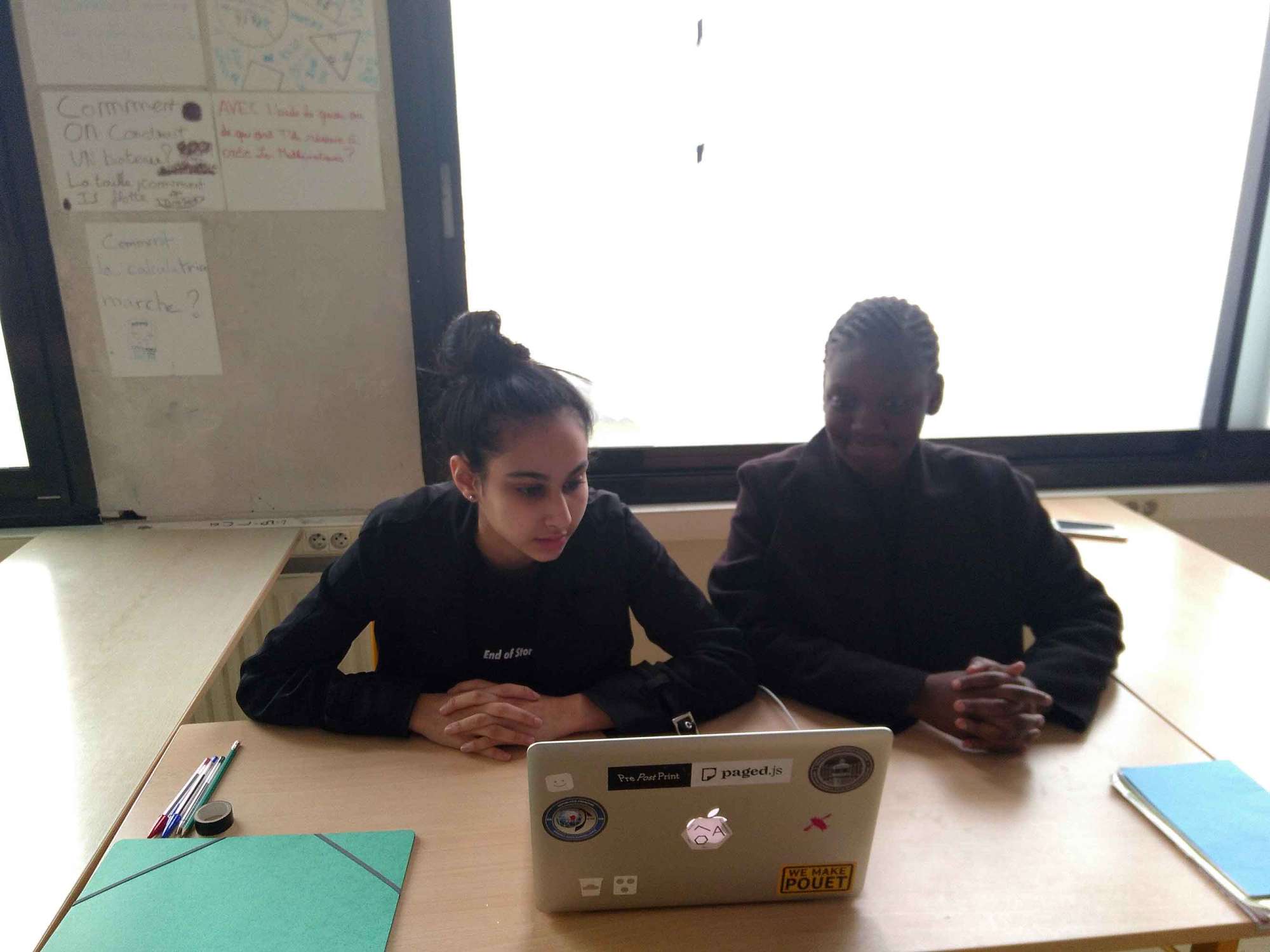
The two hours end and the newspaper is almost finished; a few corrections from the editorial committee could not be made yet, such as retaking the photo of the school with a blue sky for the editorial page.

After the workshop, Lucie and I do a final proofreading together; some elements still need adjusting, some sentences need nuancing.
Ta-da!
Wednesday April 17th, 2019, Bobigny
We arrive at the Jean-Pierre Timbaud middle school with Lucie for the last two hours with the 3ème1 class.
We drew up a list of corrections; some are about content, and we suggest they meet in groups to rephrase some sentences. There are three of us supervising, each following a group. If a group disagrees with a request to rephrase a sentence, it has to justify it to us. You can tell that proofreading and rephrasing is hard for them and that laziness wins (“no, it’s fine like that, I don’t know how to say it differently”), but we get there. The two hours fly by; the students correct directly on the printed newspaper and don’t have time to transfer the corrections to the final version in dodoc. Never mind, I’ll do it. I go around the groups so that each one explains the changes made. The workshop ends; we will all meet again at the Ateliers Partagés, for the students’ presentation of Chépa, le journal pour tou.te.s, and for them to discover their share of the printed newspaper.
Epilogue
The newspaper must be printed before May 20th to be presented at the Ateliers Partagés festival at the Gaîté Lyrique, an exhibition showing all the school projects carried out with the Gaîté Lyrique during the year.
After making the changes from the last workshop and doing the final proofreading, I export the PDF with do.doc and send it with a print order for 1,000 copies to the British online printing website Newspaper Club. The website quotes 1,500 euros including shipping to France. It’s early May, a Tuesday morning; I place the order, still with that fear of having forgotten something, that dread right before sending. The newspapers should arrive within a week. The following Thursday, Lucie calls me: the newspapers will be delivered to the Gaîté Lyrique only 3 days after the order. Wow!
On May 23rd, I meet the students at the Gaîté’s bar stage; they are going to present their project. Lyna, Ambre and Christelle will speak: they prepared a short, well-summarized presentation of the project and a few jokes in their own style. A great presentation!

Then the students discover the exhibition and the newspaper. They have a few crates of newspapers to take back to school. And they decide to start handing them out in the Gaîté Lyrique and the neighborhood. Thrilled to show their work to the world, everyone grabs a few newspapers and runs off to hand them out to anyone who wants one. They face some people’s “no thanks” and others’ questions. In any case, they look proud as they head back to school with boxes of newspapers in their arms.
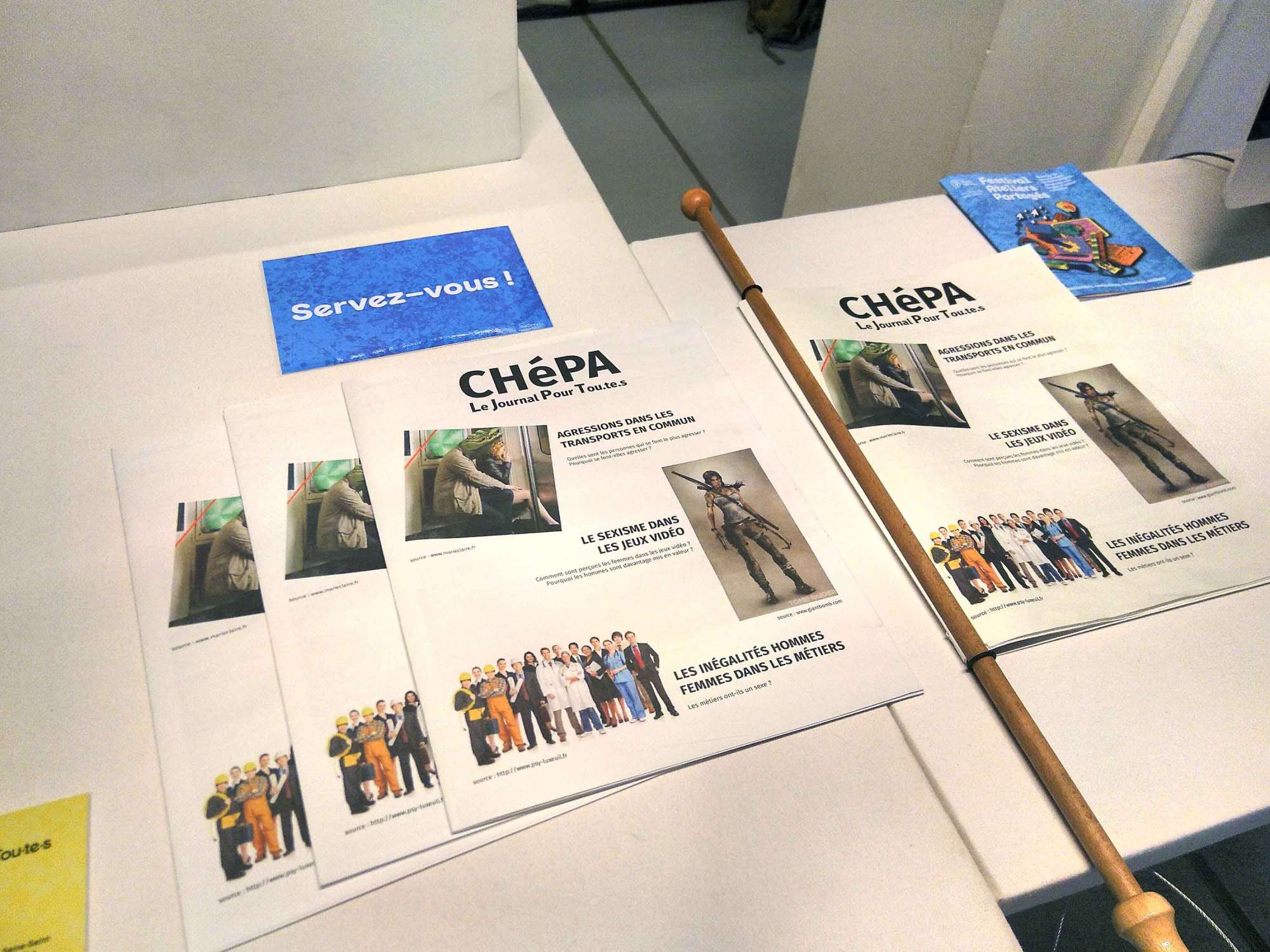
The project was led by Sarah Garcin (artist), Romain Poncato (history and geography teacher), Anne Régnier (math teacher) and Lucie Bernard (audience relations at the Gaîté Lyrique).
This project was carried out in partnership with the Gaîté Lyrique, with the support of the Conseil départemental de la Seine-Saint-Denis as part of the Educations aux Regards program.